
Denton Vigil Offers Space for Grief and Hope
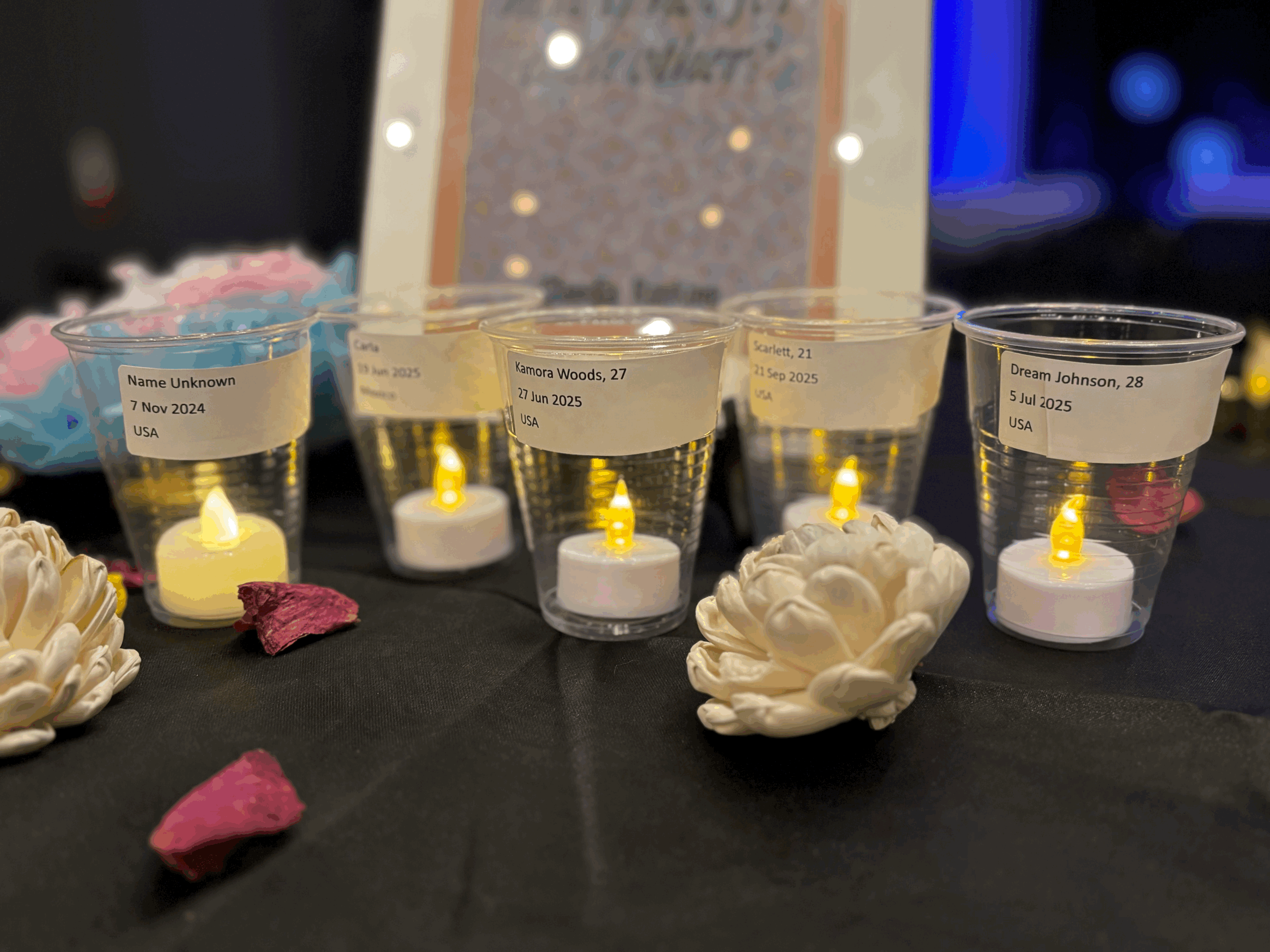
Candles at the Denton vigil bear the names of transgender and gender-nonconforming people who lost their lives this year
First United Methodist Church of Denton opened its doors Nov. 20 to host the city’s Transgender Day of Remembrance (TDOR) vigil, providing a sacred space for collective mourning, resilience and community care.
The gathering—planned and led by OUTreach Denton and PRIDENTON—brought together about 70 participants for an evening of reflection and remembrance honoring transgender and gender-nonconforming people around the world who lost their lives this year to anti-trans violence or suicide.
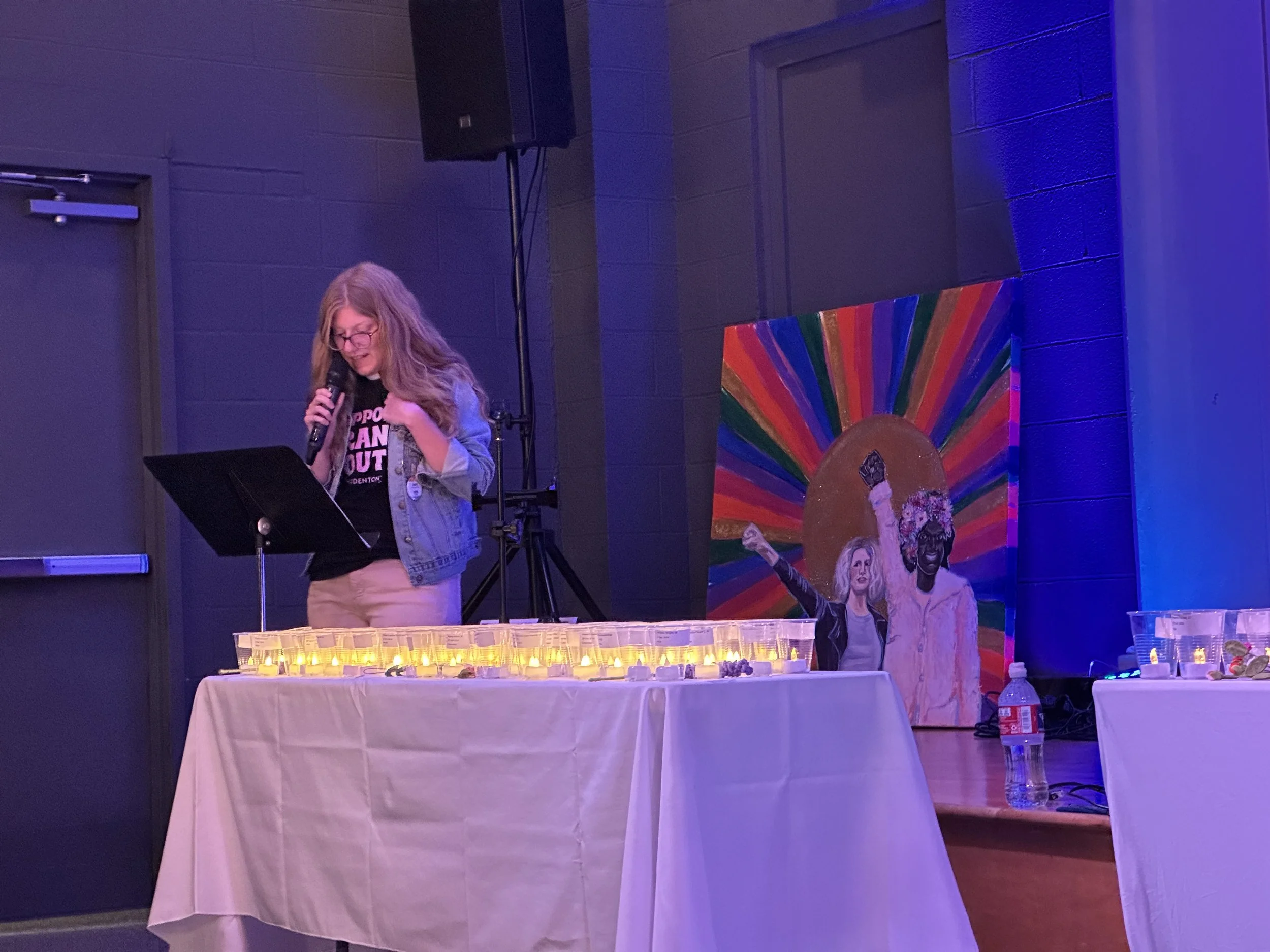
Rev. Jenny Bates leading the grounding moment at Trans Day of Remembrance.
For Rev. Jenny Bates, who has long served with OUTreach Denton, the partnership between the organizations and the church represents years of relationship-building.
“OUTreach Denton has hosted vigils for a very long time, but we’ve never had our own community space,” Bates said. “First UMC Denton had a building and a long-standing connection with our organizations, and it just fit. We were moving toward the same goal of inclusion in our community.”
Rev. Raegan Gilliland, co-lead pastor of First UMC Denton, echoed the sentiment, noting that the church’s role this year grew out of years of commitment to creating a place of true welcome.
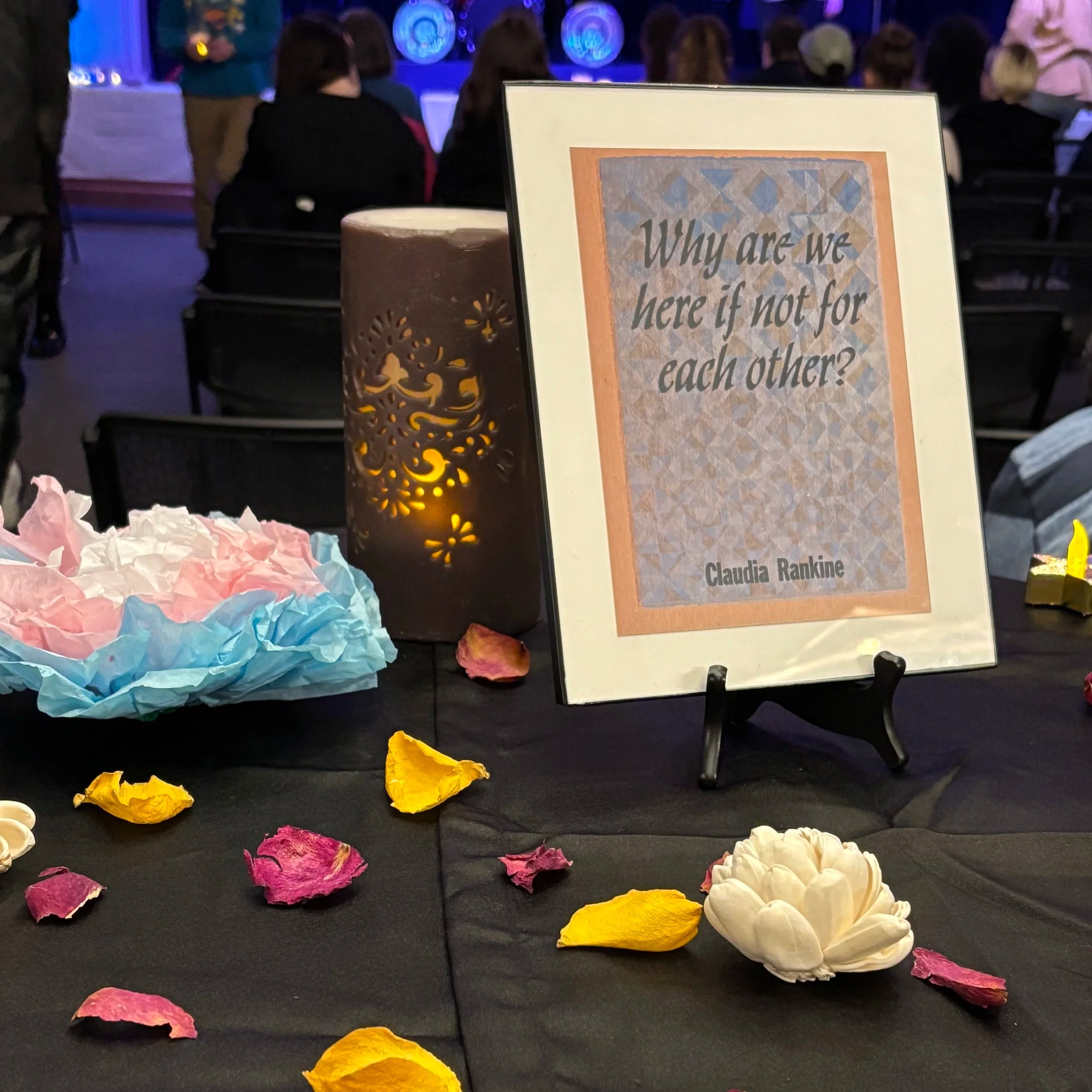
A framed quote by Claudia Rankine reads, “Why are we here if not for each other?”
“What is really beautiful is that we did not choose to host the Trans Day of Remembrance—OUTreach Denton reached out to us to see if we would be willing to host it,” Gilliland said. “This certainly did not happen overnight, and the work FUMC Denton has been doing for many years to create a place of safety for our LGBTQ+ siblings has been a journey. To earn the trust of this community takes patience and intentional work.”
Krystal Stroud, director of communications and Open Worship leader at First UMC Denton, said hosting the vigil marked meaningful progress for the congregation. “The church has done a lot of work—and still has work to do,” Stroud said. “But I was honored that we could host. We want to be a church where our trans siblings know they are seen, valued and beloved children of God.”
Preparing to host the vigil required both logistical care and spiritual intention, Gilliland said.
“Spiritually, we prayed for those who were coming into our doors,” she said. “Those who may have been wounded greatly by the church—we prayed that we would not be a place that triggers, but a place that could be a refuge of peace and comfort.”
The program followed OUTreach Denton’s long-standing TDOR liturgy, beginning with a land acknowledgment crafted by the UNT Native American Student Association and the UNT Pride Alliance. The acknowledgment recognized both the harm endured by Native communities and their historic understanding of gender diversity. Participants then heard the history of Transgender Day of Remembrance, first observed in 1999 in memory of Rita Hester, a Black trans woman murdered in 1998 in Massachusetts. The vigil highlighted that trans women of color continue to face disproportionate violence.
A grounding moment invited attendees into deep breathing and community-centered grief.
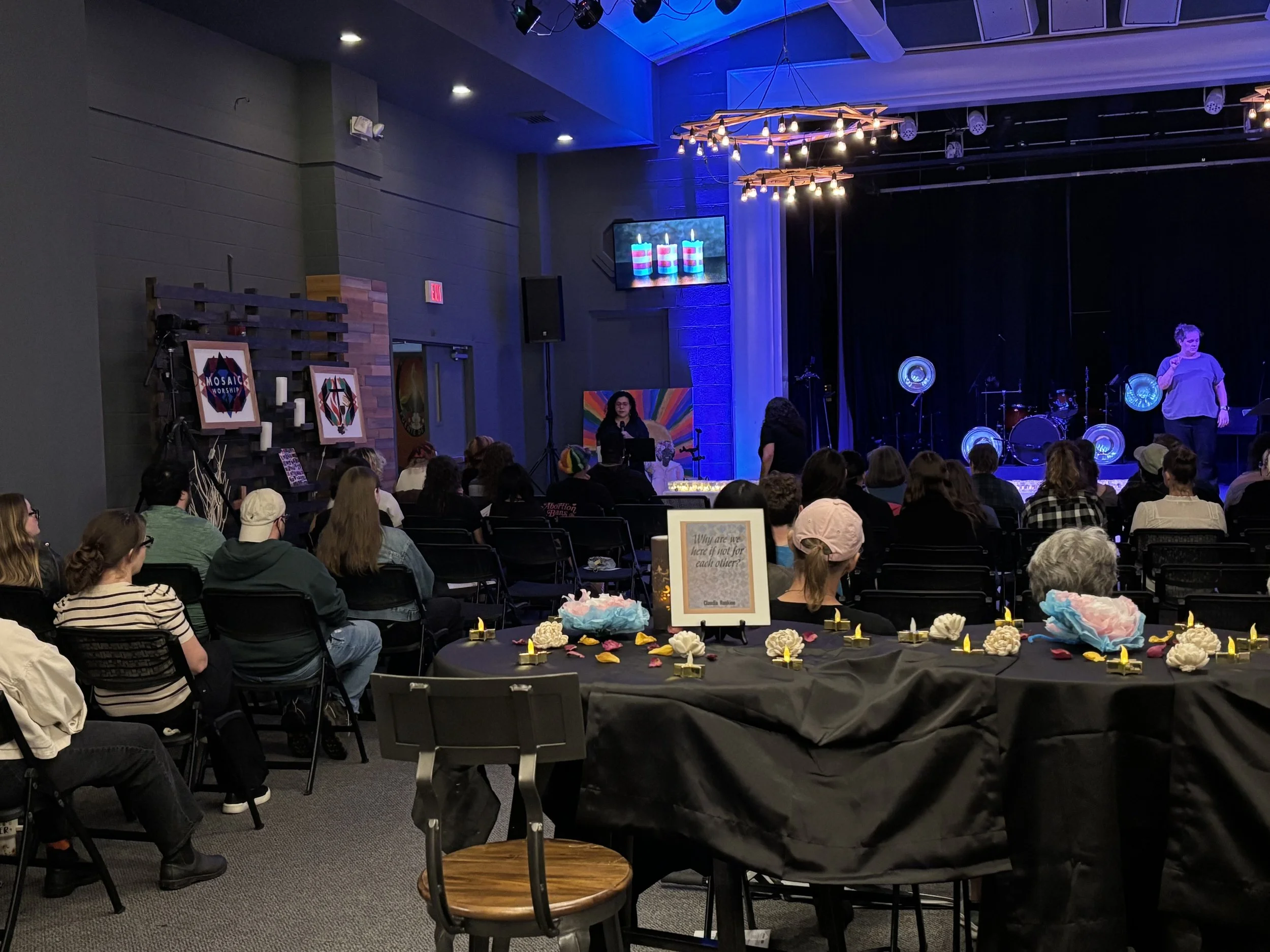
Adrienne of the OUTreach Denton Committee beginning the reading of the names.
The reading of names—between 300 and 400 globally each year—formed the heart of the vigil. Volunteers read names carefully and intentionally, including acknowledgment of those whose names are unknown. Participants received small candles labeled with an individual’s name, age, date of death and country, holding them as an act of honor.
Stroud, who read approximately 40 names, said the experience was emotionally heavy but deeply important. “I looked up every person on my list and carried their stories with me all week,” she said. “Reading the names is an honor, and it’s heartbreaking. But it matters.”
Following the readings, participants were invited to walk a labyrinth created by longtime church member Clay Thurmond, a dream he had advocated for over the years. Many carried their candles through the labyrinth as a final act of prayer and remembrance.

Candles representing lives of our trans kin gathered in the arms of an attendee to take home.
This year’s vigil also included a “resiliency moment” featuring sung community chants led by local musician and therapist Gabby Carr, of First UMC Argyle.
Looking ahead, Gilliland said she hopes the vigil continues to shape the congregation’s ministry and deepen its commitment to care and healing.
“My prayer is that we could continue to host and that this event could grow—not in names that are read, of course, but in the diversity of those showing up,” she said. “When we do these sorts of events simply because we want to care for our community, it shifts our motivation. Our motivation should simply be to be present and care for whoever walks through our doors—for one night or for many years.”
She added that she hopes the broader community will come to see First UMC Denton as a trusted place for grief, remembrance and belonging.
“I hope that First UMC Denton becomes a place that feels like a home to the entire Denton community,” Gilliland said. “We want to be the heart of Denton in every way we can.”
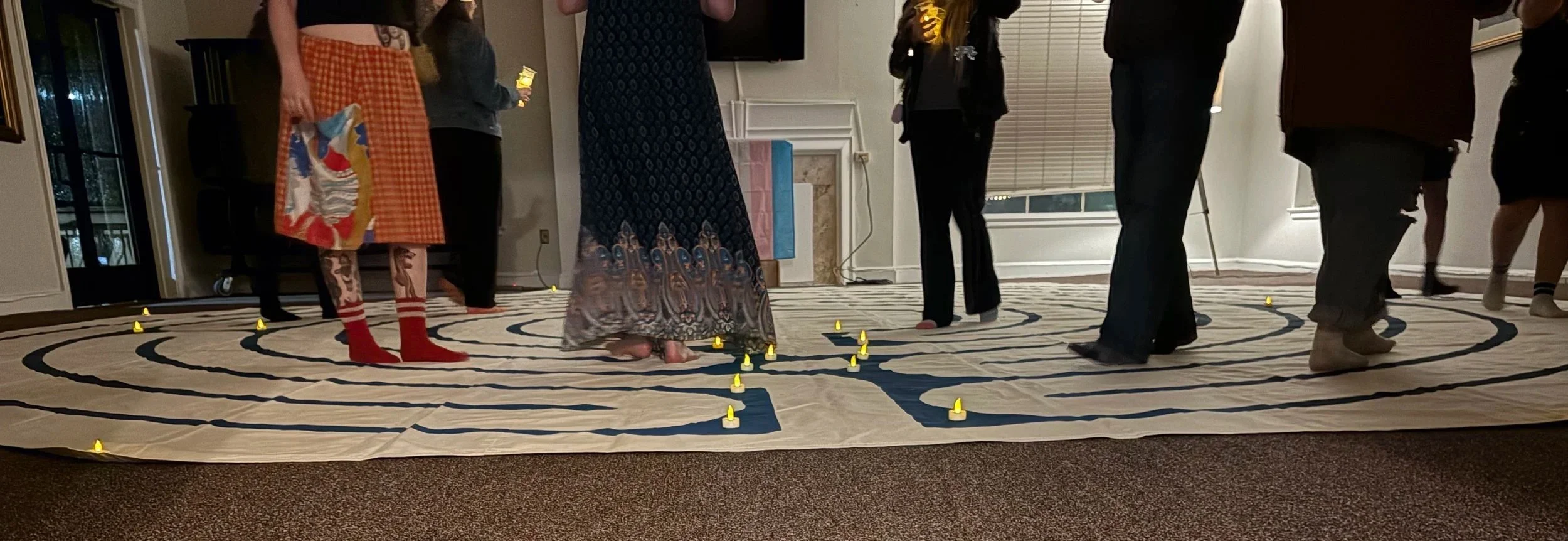
The memorial walk on the labyrinth provided by Clay Thurmond. Participants removed their shoes to walk with the candle(s) they collected during the event.
Participants lingered long after the program ended—talking, walking the labyrinth, writing love letters to trans people and resting in the safety of community.
“This was a place where people did not feel invisible,” Stroud said. “That’s the heart of the gospel—to see people as God sees them.”